Showing posts with label OUIL501. Show all posts

Monday, 27 April 2015

OUIL501 - Summative Evaluation

I feel that COP, especially the essay side of the module, has been a struggle for me, as I find that I'm not the best at writing and articulating my ideas. However throughout this module I think I have vastly improved from Level 4 COP and my essay writing skills have moved along significantly. I think that this is mainly due to the fact that I enjoyed writing about this subject much more and it's something that I am quite passionate about. I have become much more aware of the context of my work, which helps me to synthesise both my essay and my practical work to create a successful project. I have improved my research skills, as I enjoyed researching my subject this year and it was much less of a boring task. I found it easier to collect a wide range of sources and to document them also. Last year I found it harder to translate my research into my essay but this year I can definitely tell how my research has informed both my essay and my practical work.

Thinking what context my work will exist in has definitely developed the way I approach image making. When my work has a distinct purpose I find it easier to evaluate the way I am working and make critical decisions about how I should approach a piece of work. There were many problems with the way I approached making a book during Level 4 COP, and I used what I had learned from my mistakes last year to vastly improve the way I approached image making this year. I chose to make my book digitally rather than using traditional techniques to give a much cleaner and more professional look. I also used an actual font rather than hand drawn type, which I used last year, which proved to be quite hard to read when printed out on a small scale.

The narrative of my work was a definite strength. In the feedback tutorials I was told that the story linked well with my essay title and that the contrast between the naive children's style illustrations and the honest and brutal narrative worked really well. I was quite organised with my time and didn't leave anything to the last minute, I worked hard on getting the book finished to a high standard with plenty of time left to finish other aspects of the module. At the start of the project I initially wanted to create 3 books, but it was suggested that this would be too much work, so I decided to create only 1 book, but to a very high standard, I think this was my main improvement from last year, where I gave myself too much work to do, so I wasn't happy with the quality of the finished work.

I think the main weakness within this module was definitely my essay. Although I enjoyed doing the research, as the meat industry is something I'm quite interested in, I still found it hard to actually write the essay to a standard that I was pleased with, so I think it will affect my overall grade. I also found the study tasks quite hard, because I didn't blog them straight away, as I find analysing images difficult, and I was struggling to get back into the flow of analysing things after the end of Level 4, so I ended coming back to the study tasks a while after we had been briefed them, so the information we were given to support the tasks wasn't fresh in my mind. In hindsight I should have just approached Richard and asked for help with them, but at the time I felt like I was too busy with others modules to do this, so throughout Level 6 I will ask for help more often rather than leaving it and struggling when I come back to it.

During Level 6 I intend to:

  • Make sure that I am fully invested in whatever I choose to research, so that I can do my best both with the practical and essay side of the module.
  • I will ask for help whenever I need it to avoid not doing something, coming back to it, and struggling more than I did in the first place.
  • I will push myself to create as much work as possible to a high standard, now that I feel I have a better grasp of what my limits are, I can safely push them to challenge what I'm capable of.
  • I will blog everything as I go along, and do a lot research into my Level 6 subject over the Summer so that I am well prepared for when we return.
  • I want to try and gather more first hand research, rather than secondary, even if this is just photo reference imagery to help me with the practical tasks.

OUIL501 - Final Practical Response

I'm very pleased with the outcome of my final book, I received a lot of praise at the final crit on the impact of the story and the relationship that I created between image and text and I think that I used colour well to create a certain mood and to evoke an emotional response in the reader. I tried to make the story a little bit humorous as I was trying to mock the naivety of consumer's views towards the meat industry and the slaughter process. I think I got the balance between adult humour and the aesthetic of a children's book exactly right in order to fool the reader into believing this to be a real children's book, and to then be shocked by the narrative when they read it. I was very pleased with the print quality, as I decided to print the front pages on thicker paper and the inside ones on thinner stock, this gave it more of a realistic look. The next book that I create I want to properly bind it with a hardback cover.


OUIL501 - Final Essay Response

OUIL501 - Final Crit and Feedback


Although this final crit wasn't exactly useful, because I couldn't really change anything about my book at this stage, I did find the feedback to be really reassuring in that my book was successful. 
A few people mentioned that my book had a very clear and well executed concept, that the sarcasm and humour contrasted really well with the deep subject, also because of the way it was designed to appear to be a light hearted children's book. 
Through my feedback I can see that my work is obviously informed by contextual research and links well to my essay question. This was something that I was concerned about at first, that the practical element of my work didn't link directly to my essay question, but I feel much more confident that it does after this feedback.
Looking back on my work now I am happy that I decided to change my idea from simply creating a painting of layered farm animals to this children's book because it gives my project much more context and has given me ideas for future work. 

Sunday, 26 April 2015

OUIL501 - Project Synthesis

My essay title was, How demand and growing consumerism has changed and developed the meat industry. I chose this title because I have always been interested in the industry and how consumers views of it are skewed by the media. My practical work was kind of a commentary on the naivety about the slaughter process, because many consumers don't consider the reality of the meat industry and believe the sugar coated image they are given by the media. As our consumerist society has grown the meat industry has grown with it and had to develop new ways of producing enough low cost meat to fulfill demand. Animal welfare isn't always a priority in these production methods but the way that we are fed a skewed view of factory farming leads people to believe a kind of fairy tale version of it. I wanted to illustrate the typical slaughter process under the disguise of a children's book, to show the juxtaposition between what actually happens when a cow is slaughter compared to the skewed image that people have in their minds.

Saturday, 25 April 2015

OUIL501 - Book Development

I started making plan sketches for my book, I started researching the slaughter process, watching videos and reading articles. I wanted to keep the story quite short and simple, with a blunt narrative, which is often the tone of childrens books, so I kept the story to 8 pages long. I started out by planning each page and then painting it using water colour, but after I finished one I didn't think it looked clean and precise enough to be the final image, so I decided to finish them off digitally.


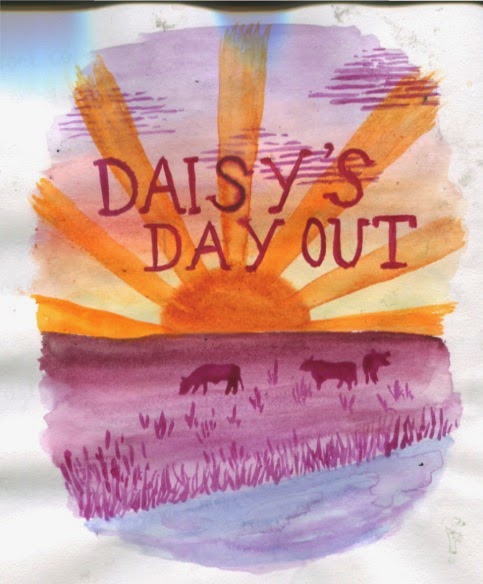
I first painted the front cover with watercolours rather than digital and I really liked the outcome, I think mainly because there was a lot less detail in the front cover than in the pages, so it was easier to create a nice image.


OUIL501 - Development Sketches

After I had done a bit more research into the aesthetic of my book, I began making sketches and playing around with different styles. I had a clear image in my head of how I wanted it to look. I wanted to portray the classic 1950's style childrens books, with bold shapes and muted, bold colours. A few artists that I had looked at inspired me to try and give my work a collage effect.

I first tried doing this digitally even though I had intended to create all images by hand using watercolour, as I thought it would be easier to create something a bit more professional, seeing as I hadn't really used watercolours to create a well put together image before.
In the image above I was trying to go for quite an abstract feel, but in the end I didn't think it really worked. To create more of an emotional bond with the reader I wanted it to be a bit more realistic but still child like.
I also decided that I would not mention anything about the book being set in a slaughter house, because I wanted to deceive the reader into thinking this was a classic children's book about a cow.


OUIL501 - Development sketches

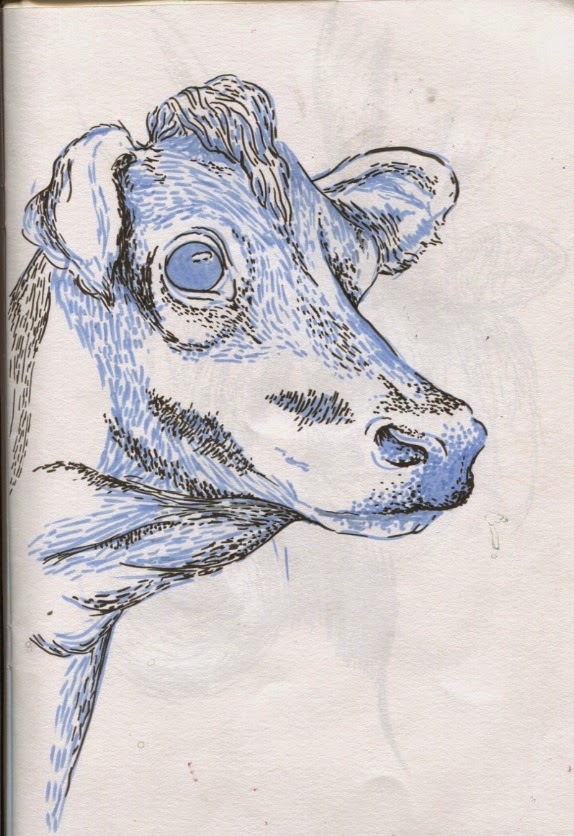
After getting some feedback on my project I decided that I would create a childrens book looking at the slaughter process of animals. Although I didn't know what I wanted my book to look like. I went to a local farm and took some research imagery to help me come up with some ideas. I started doing some sketches using mark and line again to create texture. I was still pretty stuck on the aesthetic of my book, so I started researching childrens' books on pinterest.


This was one of my favourite images that I created. I tried to show tone using texture rather than block colour. I think the simple combination of two colours makes the image work really well aesthetically. 

Tuesday, 10 March 2015

OUIL501 - Vintage Ladybird Books

I have a small collection of vintage illustrated children's books, which I looked at for reference when thinking about how I should approach my book. The narrative of the Snakes book was exactly how I wanted mine to be, blunt and straight to the point, as I think, reading this as an adult, already has an element of humour to it. Most of the books had a similar style of illustration, using quite realistic looking drawings with a simple and realistic colour scheme, mainly because they are instructional books, however the Bedtime Rhymes book was quite different, the style was much brighter and more vivid colours and the drawing technique was much less true to life, focusing more on using block shapes and colours.

Friday, 6 March 2015

OUIL501 - Vintage Ladybird Books


One thing that inspired me when thinking about the aesthetic of my children's book was vintage Ladybird books, especially the colours that are used, they always seem quite faded and neutral. I want to mix this with my style of creating texture and bold image. 
The narrative style of Ladybird books is also something that I want to try and include in my own book, in the instructional books particularly, the narrative style is quite blunt and straight to the point, obviously to make it easy for children to understand. I think using this style of writing will help to give the appearance of a children's book yet adding adult humour will mock the context.


Wednesday, 4 March 2015

OUIL501 - Vintage children's book illustration


I found these illustrations on Pinterest, they are Polish vintage children's book illustration, and because I don't speak Polish, I found it hard to find out who the artist was. But I was really inspired by these, mainly because of the colours, they're bright and muted at the same time, and the colour palette is really simple. Each page is mainly blue and black with one pop of colour to create a focal point, which I think creates a really pretty and quite relaxing image. 


Tuesday, 3 March 2015

OUIL501 - Olga Demidova


I found Olga Demidova's work on Ohh Deer's Facebook page and fell in love with it instantly. The colours and textures in her work definitely influenced how I decided to go ahead with completing my work. In the first image especially I think that everything works together to create a lovely looking image, the foreground frames the rest of the scene well and the colours all compliment each other well to create a warm and inviting aesthetic that works perfectly for children's book illustration. I will definitely be keeping my eye on her work for future inspiration.

Monday, 2 March 2015

OUIL501 - Laurent Moreau

After doing some research I found the work of Laurent Moreau. His style of work is exactly what I want to try and incorporate and mix with my own style of working for my children's book.


I think that using bold, block shapes with one tone of colour, then using marks to create texture, will work best for the context of this brief, as it fits the style I want to convey, it looks kind of like collage but using paint. Using this sort of childish way of working is a good juxtaposition to the content of my book, which will be quite gruesome while explaining the slaughter process of farm animals.


OUIL501 - Children's book illustration

Follow Becky's board Childrens book illustration on Pinterest.

I have decided, that to add more context to my practical work, I will make a mock children's book, I have looked at work on Pinterest to get inspiration for the aesthetic of my work. I will create a story around the slaughter process of cows. At first I was going to create 3 seperate books looking at different farm animals but realised this would be way too much work for the time I had left. Even though colours on farms aren't bright or varied, I want my work to have a bright colour palette in order to communicate the aesthetic of other children's books. I thought that the juxtaposition between the imagery of childrens book illustration and the gory subject of animal slaughter would be a good way to create something quite comical.

OUIL501 - First hand research imagery

To get some reference imagery for my children's book I went to a nearby farm and took some pictures of the animals. I mainly wanted to get a feel for the colours and textures that you see on a farm so that I could recreate these in my work.


OUIL501 - Our Daily Bread - Nikolaus Geyrhalter

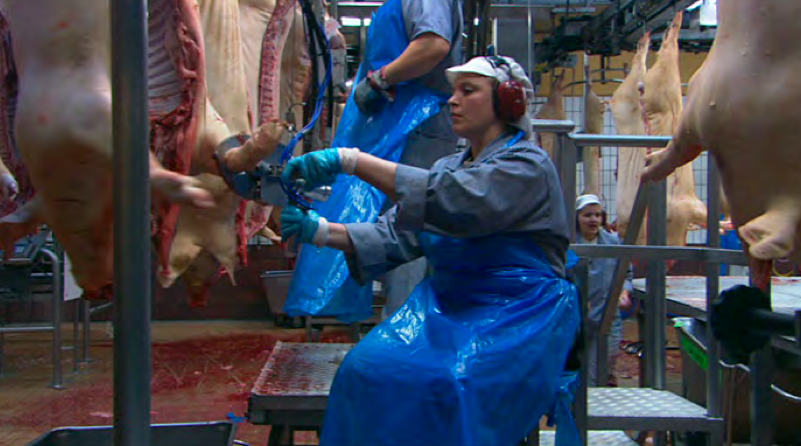
I watched Nikolaus Geyrhalter's documentary 'Our Daily Bread' which shows how modern food production companies use technology to maximise efficiency, profit and consumer safety. The documentary doesn't contain any voice overs or interviews as the director wanted the viewers to be able to form their own opinions. The goal of the documentary was to provide a realistic view of modern food production companies. 


Sunday, 1 March 2015

OUIL501 - Practical Feedback tutorial

After speaking to Eleanor about the practical side of my project I have decided to take my work in a different direction. Instead of creating a layered drawing I have decided I want to create a mock children's book, that will look at the slaughter process.

I think that the context of a children's book is much more powerful as a piece of work, because it represents the naivety of the general public regarding the meat industry and the slaughter process. I think the light hearted look of a children's book will contrast well with the shocking imagery of slaughter.

I don't think that the book would be specifically targeted at children, because of the narrative, I want it to be targeted more at an adult audience because it is mocking the naive nature of children's books and their blunt nature when explaining processes.

Thursday, 26 February 2015

OUIL501 - Essay feedback tutorial

My feedback tutorial went really well and I was pleased with the feedback I received. I was surprised that I had done well with my essay as I feel that essay writing really isn't my strong point, but I only needed to re-write my conclusion and add in the Harvard referencing to get a reasonable grade. I'm fairly happy now with the fact that the practical side of this module relates well to my essay and will be a good addition to the brief, which is something I was worried about earlier on, as I didn't know whether or not my project had a good enough context.

Wednesday, 28 January 2015

OUIL501 - Naomi Klein - No Logo


  • No Logo talks about how corporate branding has taken over America
  • The rise in consumerism forced corporations to create a brand for themselves in order to create brand loyalty with consumers and to stand out from the competition as more and more brands surfaced.
  • As manufacturing processes developed and upgraded and products began to be made in large scale factories, more and more variations of common products were being made, and different sales strategies needed to be employed, hence the development of the brand. 
  • The purpose of advertisement changed from 'delivering product news bulletins' to creating a branded image of a particular product.
  • Brands had to create an emotional response in their customers, to make themselves appear more human in order to appeal to consumers. 
  • Brands became important to children and young teens as a way to fit in, as young people began to have more of a disposable income and their own identity. 
  • Brands aimed their advertisements towards children to instil brand awareness, which would grow as they grew themselves. 
  • This links to Pester Power.
  • Brand Logos have become more popular as they have become more visable, the product is more about the logo than the use of the product itself. 
  • "This scaling-up of the logo's role has been so dramatic that it has become a change in substance. Over the past decade and a half, logos have grown so dominant that they have essentially transformed the clothing on which they appear into empty carriers for the brands they represent. The metaphorical alligator, in other words, has risen up and swallowed the literal shirt."

Sunday, 25 January 2015

OUIL501 - ‘I felt like a piece of trash’ – Life inside America’s food processing plants

http://www.theguardian.com/world/2014/dec/21/life-inside-america-food-processing-plants-cheap-meat

Until now, little attention has been paid to the workers who plant and harvest produce in the American south or who work in the high-speed packing houses in the midwest.

the meat industry was becoming overwhelmingly staffed by recent immigrants – many without legal employment status – as a way of pushing production lines to go faster and faster.

Undocumented workers, many from Mexico and other parts of Latin America, formed a perfect corporate workforce: thankful for their pay cheques, willing to endure harsh working conditions, unlikely to unionise or even complain.

In 2006 and 2007, when the American mortgage crisis began to peak and then stock markets crashed worldwide, the freedom to run faster production lines positioned Hormel to capitalise on demand the economic downturn created for budget-friendly meat like Spam without significantly increasing its workforce or raising wages to match the elevated output.

in 2002, Hormel’s production lines were running at 900 pigs per hour; by 2007, they were running 1,350 pigs per hour. 

The speed of pork production is not only affecting the health and safety of workers on the line; now lines are moving so fast that the safety of consumers is being placed at risk. Inspectors have discovered pig carcasses with lesions from tuberculosis, septic arthritis (with bloody fluid pouring from joints) and smears from faecal matter and intestinal contents.

 when the whole system is built around producing cheap meat, it means that fewer and fewer low-income families, even in the developed world, have access to high-quality meat. So it’s not enough to buy grass-fed steaks for your own family and then tut-tut at poor families lined up at McDonald’s or filling their shopping carts with Spam.