Showing posts with label OUIL601. Show all posts
Showing posts with label OUIL601. Show all posts
Thursday, 14 January 2016
OUIL601 - Summative evaluation
Overall I'm quite happy with the final outcome of both the essay and the practical, and the skills that I have gained throughout this module. Even though I had a bit of a unsure start with trying to decide on my essay question, I quickly got into the flow of researching the relevant topics and found that this also helped me to quickly develop the practical elements of my project. After doing research into illustrated educational material and different genres of children's literature, I decided that the most suitable practical solution would be to create a children's story/activity book, as it would allow me to create a narrative that could intertwine education and an engaging story. I intended to create illustrated merchandise, from one of the characters in my book, but I underestimated the amount of time it would take me to actually finish the story to a high enough standard, so this may be something that I come back to in the future, although I didn't get chance to create merchandise or a puzzle book, I feel like my story works very well as a stand alone piece. My research into anthropomorphism taught me that having animals in stories can help children to understand difficult topics and get them to identify with a character. This was one of the reasons I decided to change the main character of my book from a child to an animal, it would fit better with a more simple narrative, and would help me convey the educational element of the narrative better. Because of time constraints I decided that I would use a limited colour scheme and only one medium, that I would finish off digitally, as my initial final images were taking far too much time, and would have ended up being a detriment to the overall quality of the book.

OUIL601 - Final book

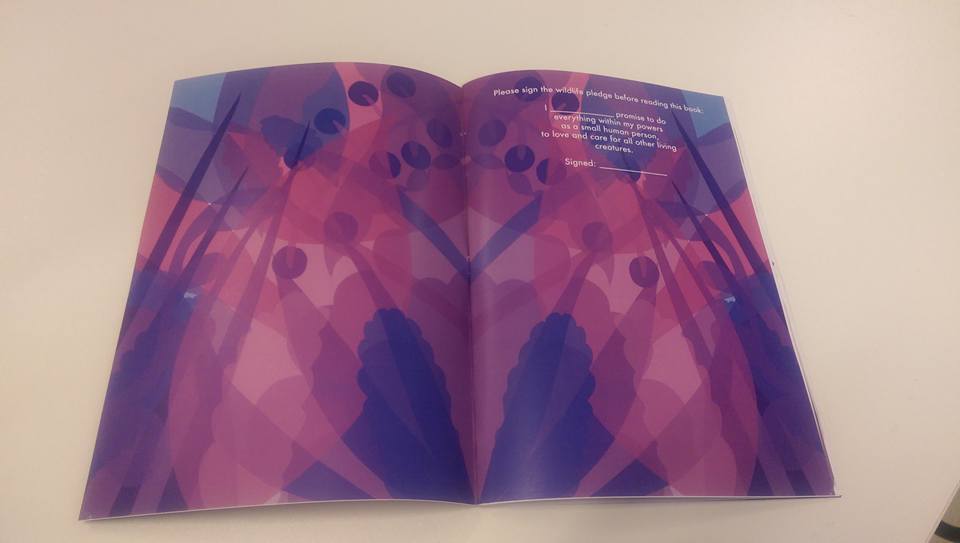

I was able to get my book printed and bound with quite a lot of time to spare, I was really pleased with the overall look of the finished product, I think the images worked really well when in context and placed next to each other. However the cover got slightly damaged because of the type of paper it was printed on, so has slight marks on the front, which doesn't look too bad, just adds a bit of texture to it.
The front and back covers are just bold shapes layered on top of each other, using the colour palette from the book, to create a simple texture.
OUIL601 - Final images PDF
Here is the PDF of my final book. I'm really happy with it, although it took way too long, and I think I made it a bit too long, but there overall quality of the images was good, I was pleased with the way they looked with the combination of watercolour and digital enhancement. I think if I were to do this again I would probably make the story a bit shorter, and maybe only use watercolour to create texture rather than using it to do the detail as well.
I think the book is synthesised well with my dissertation and successfully illustrates the points of my essay, that illustration can be used to inspire an interest in wildlife conservation in young children.
OUIL601 - Merchandise mock ups


At the beginning of my project I wanted to create a range of merch to go alongside my book, however I ended up using all of my time to finish my book. I originally wanted to create a puzzle book to go with the book, and then a range of stationary. I would have created a campaign and maybe a reward system, that would reward the children for completing the puzzles.
I thought of 'I'm a snail friend' as a type of campaign thing, the design could be printed onto things like t-shirts and pencil cases and be given as a reward for completing different challenges/puzzles.
Although I didn't get to actually make this properly during this module, I may take the idea over into OUIL603 and do a range of products based on a children's character that I have created.
OUIL601 - Project synthesis
The title of my essay was 'How can illustration be used to inspire an interest in wildlife conservation in young children' I chose this title, because I became increasingly interested in how illustration can be used to educate future generations on important topics, off the back of the big success of my practical project during level 5. For the practical side of the module I decided to create a story book, which followed a snail travelling around his back garden, giving out gifts to disadvantaged wildlife, while learning about their plight and what can be done to help them. From my research into existing educational illustrations for children, and children's literature, I decided that doing my book in a half book half comic style format was best for incorporating all of my research into the narrative. I discovered through my research that it is said that anthropomorphised animals can possibly hinder a chid's learning, because they begin to develop a skewed view of the real world, but I chose to to have partially anthropomorphised animals in my book because I think that the age my book is targeted at would be able to differentiate between reality and fiction, and would still have the benefits of using animals in narrative, by posing the tough subject of wildlife conservation in a lighter way that is easier for children to understand.
Tuesday, 12 January 2016
OUIL601 - What I would have done if I had the time
So I really wanted to create a range of illustrated merch using the snail character I created, however with how long everything took to complete, there was absolutely no chance of doing that.
I feel like it could work well to take my character onto different platforms, like an app, that would provide activites, a bit like The Wild Time app, but more focused on education. That way I could create a wider range of merchandise that relates to the app as well as the book.
The Gruffalo is a good example of how a children's book can be turned into a lot of different types of merchandise.


I feel like it could work well to take my character onto different platforms, like an app, that would provide activites, a bit like The Wild Time app, but more focused on education. That way I could create a wider range of merchandise that relates to the app as well as the book.
The Gruffalo is a good example of how a children's book can be turned into a lot of different types of merchandise.


I'd want to create a range of illustrated stationary, that would also provide educational information and maybe go with an activity book or colouring book.
OUIL601 - Laurent Moreau

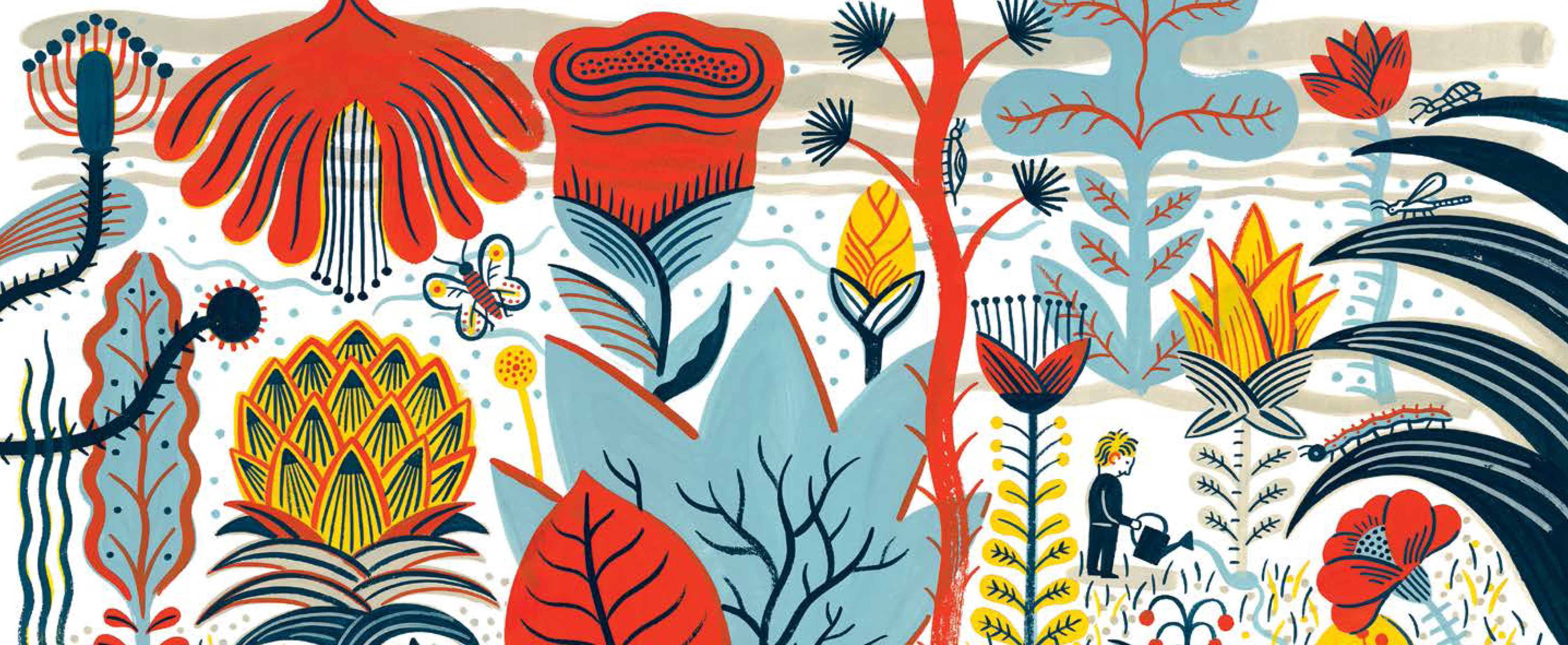
I proper love Laurent Moreau's work, it's quite different from the other artist's I found, a lot brighter and more abstract, but I like that he creates weird looking shapes with bright block colours, I think this would work quite well in a children's book, to make the narrative more interesting.


OUIL601 - Brigette Barrager


I found Brigette Barrager on Pinterest, as always, and I much prefer this sort of colour scheme. I really like the mixture of pinks, blues and purples. These images are much less detailed than Wild and The Little Gardener by Emily Hughes.
OUIL601 - Emily Hughes

I knew of Emily Hughes a while ago but forgot she existed. I found her again recently on Pinterest when I was looking for ideas for my practical.
She has two naturey themed books, 'Wild' and 'The Little Gardener'

The colour schemes of the book aren't what I'm thinking of using, but the colour palette is similar in that it's quite limited, which I think works quite well, coupled with the detailed patterns, I think it looks right nice.
Sunday, 13 December 2015
OUIL601 - Watercolours
These are the initial watercolour pages of my book, which I scanned in and worked on digitally to finish them off. I need to have a lot more practice using watercolours, because a lot of the time I messed up, or the colours went murky, or I just couldn't get the idea that I had in my head out and translated onto the page.
The finished digitised images look quite different to these ones, because I spent a good few days working on them, hence why it took me so long to finish the book.
Thursday, 3 December 2015
OUIL601 - Contextual references
http://www.amazon.co.uk/Dont-Like-Koala-Sean-Ferrell/dp/1481400681
emily hughes illustrator
Where Does Kitty Go in the Rain? by Harriet Ziefert, illustrated by Brigette Barrager
Up in the Garden and Down in the Dirt by Kate Messner, illustrated by Christopher Silas Neal
Please, Mr. Panda by Steve Antony
Laurent Moreau
Miche Wynants
Jon Kalssen - CONTACT JON
lizzy stewart illustration
Isabelle Arsenault
Emily Sutton illustration
Chris Hagen illustration
emily hughes illustrator
Where Does Kitty Go in the Rain? by Harriet Ziefert, illustrated by Brigette Barrager
Up in the Garden and Down in the Dirt by Kate Messner, illustrated by Christopher Silas Neal
Please, Mr. Panda by Steve Antony
Laurent Moreau
Miche Wynants
Jon Kalssen - CONTACT JON
lizzy stewart illustration
Isabelle Arsenault
Emily Sutton illustration
Chris Hagen illustration
OUIL601 - Things to do in your garden
http://www.gardenwildlifehealth.org/best-practice-advice/
http://www.rspb.org.uk/makeahomeforwildlife/advice/gardening/wildlife-friendly_garden.aspx
Key habitats in a wildlife garden
- Long grass provides a safe area for egg laying and provides shelter from predators
- Plant different species of plants and shrubs to provide year round food sources.
- A water feature with different depths is good for wildlife, shallow areas for birds to drink, deeper areas provide shelter for aquatic instects
- Growing climbing plants against walls provide safe places for birds to shelter and nest
- A thick and well developed hedge provides a safe sheltering place for wildlife.
- A bat box can be used for bats to nest in
- A pile of leaves will often be used by hedgehogs
- Short lengths of straw bunched together and hug are perfect nesting spots for ladybirds.
- lengths of dead wood is good for different species of beetle
- Early and late flowering plants provide nectar for insects at critical times in the year
- Ivy is a late source of nectar for insects
- Annual plants that provide seeds in late summer are a good source of seed throughout autumn.
- Save rainwater for watering your garden plants
- Avoiding using peat, peat extraction destroys vital wildlife habitats
http://www.rspb.org.uk/makeahomeforwildlife/advice/gardening/wildlife-friendly_garden.aspx
Key habitats in a wildlife garden
- Long grass provides a safe area for egg laying and provides shelter from predators
- Plant different species of plants and shrubs to provide year round food sources.
- A water feature with different depths is good for wildlife, shallow areas for birds to drink, deeper areas provide shelter for aquatic instects
- Growing climbing plants against walls provide safe places for birds to shelter and nest
- A thick and well developed hedge provides a safe sheltering place for wildlife.
- A bat box can be used for bats to nest in
- A pile of leaves will often be used by hedgehogs
- Short lengths of straw bunched together and hug are perfect nesting spots for ladybirds.
- lengths of dead wood is good for different species of beetle
- Early and late flowering plants provide nectar for insects at critical times in the year
- Ivy is a late source of nectar for insects
- Annual plants that provide seeds in late summer are a good source of seed throughout autumn.
- Save rainwater for watering your garden plants
- Avoiding using peat, peat extraction destroys vital wildlife habitats
Wednesday, 2 December 2015
OUIL601 - Tutorial 26/11/15
Cop tutorial on my birthday, yay! couldn't think of anything better to do on my birthday.
I was really pleased with the feedback I got from my essay, I was happy that there were no glaring mistakes in my essay and overall it was quite good.
I came out of the tutorial with a proper clear sense of what I needed to do afterwards:
- All 3 chapters need a clear introduction and conclusion
- Slim down the first chapter, it's a bit waffley
- Write out the key points of the chapters and make sure these are evidenced in my practical work.
The only thing I'm worried about is that I'll end up repeating myself in all the different introductions and conclusions, especially in the massive big first introduction and the final end conclusion.
I was really pleased with the feedback I got from my essay, I was happy that there were no glaring mistakes in my essay and overall it was quite good.
I came out of the tutorial with a proper clear sense of what I needed to do afterwards:
- All 3 chapters need a clear introduction and conclusion
- Slim down the first chapter, it's a bit waffley
- Write out the key points of the chapters and make sure these are evidenced in my practical work.
The only thing I'm worried about is that I'll end up repeating myself in all the different introductions and conclusions, especially in the massive big first introduction and the final end conclusion.
Tuesday, 1 December 2015
OUIL601 - I've started the final images.
Finally I've finished doing the initial sketches and writing the words and figuring out how everything fits together. I'm sure this won't be the last bit of tweeking that I do, but now I can finally start making the final images.
I cut the length of the book down quite a lot because it was going to end up being over 40 pages which is ridiculous.
I over estimated how long it would take to write each section about each animal, so I've cut it down to looking at just 4 different animals, which is still enough to get a decent story out of I think.


I cut the length of the book down quite a lot because it was going to end up being over 40 pages which is ridiculous.
I over estimated how long it would take to write each section about each animal, so I've cut it down to looking at just 4 different animals, which is still enough to get a decent story out of I think.


I've been using a combination of watercolour, goache, coloured pencils and acrylic. I like the really textured effect it gives, but it takes a really really long time.
I intend on scanning all the images in after I've finished them to add the text in Photoshop.
Monday, 30 November 2015
OUIL601 - How global warming has effected wildlife.
- Animals and also plants that are suited to living in colder climates will need to move towards higher grounds and polewards, even with just a slight change in temperature.
-This has already been witnessed in places like the Alps, Australia and parts of Costa Rica
-Certain species of fish have been seen moving northwards from where they were originally found.
-A rise in sea levels of just 50cm could cause sea turtles to lose their nesting beaches, and also affect the sea turtle population, as ground temperature affects the gender of the eggs.
-A lot of migratory species have been affected by global warming, as they instinctively know when to migrate from the change in seasons, but as temperatures change this confuses them.
-This also applies to plants to sprout at certain times of year, they either appear at the wrong time and subsequently die out, or they don't appear at all.
-This lack of plantlife also affects hibernating species, as when the animal awakens, their is no food for them to eat, because the plantlife has sprouted at the wrong time or hasn't sprouted at all.
-Global warming also creates severe droughts, as the atmosphere sucks all the moisture from the ground, destroying habitats are water dwelling species and animals that rely on these sources of water to survive.
-This has already been witnessed in places like the Alps, Australia and parts of Costa Rica
-Certain species of fish have been seen moving northwards from where they were originally found.
-A rise in sea levels of just 50cm could cause sea turtles to lose their nesting beaches, and also affect the sea turtle population, as ground temperature affects the gender of the eggs.
-A lot of migratory species have been affected by global warming, as they instinctively know when to migrate from the change in seasons, but as temperatures change this confuses them.
-This also applies to plants to sprout at certain times of year, they either appear at the wrong time and subsequently die out, or they don't appear at all.
-This lack of plantlife also affects hibernating species, as when the animal awakens, their is no food for them to eat, because the plantlife has sprouted at the wrong time or hasn't sprouted at all.
-Global warming also creates severe droughts, as the atmosphere sucks all the moisture from the ground, destroying habitats are water dwelling species and animals that rely on these sources of water to survive.
Monday, 23 November 2015
OUIL601 - Brooke Barker
Illustrator Brooke Barker has a tumblr blog called sadanimalfacts.tumblr.com where she literally just illustrates sad animal facts, they're so cute.


I found her whilst I was looking for some interesting wildlife facts to put in my story, I think this is the perfect balance between realistic and anthropomorphising an animal, by giving it it's own voice and opinions, it becomes easy to relate to, but also obviously still an animal, easy for to differentiate between fact and fiction for children.
OUIL601 - I got a reply finally!
During my research I came across an organisation that works with young teens to try and inspire them to follow a career in wildlife conservation.
I emailed their contact details asking if they would like to take a look at my book after I finished, and they replied! yay!

I emailed their contact details asking if they would like to take a look at my book after I finished, and they replied! yay!

Sunday, 22 November 2015
OUIL601 - Target Audience
I finally decided that the target age for my audience would be, as well as the parents, ages 5-7.
One of my favourite publishing companies is Flying Eye Books, they have different categories when searching through their books, one of them being books for ages 5-7.
I had a little search through that section to try and find some inspiration and get a feel for the type of words used in these books.


One of my favourite publishing companies is Flying Eye Books, they have different categories when searching through their books, one of them being books for ages 5-7.
I had a little search through that section to try and find some inspiration and get a feel for the type of words used in these books.
The first one I came across was one of Ella Bailey's One Day on our Blue Planet series, this one was in the Antarctic.
The majority of the pages seem to be very image based and less text, which looks very nice, but it may be hard for me to fit all of the information and facts in, with the amount of pages that I want to limit myself to.
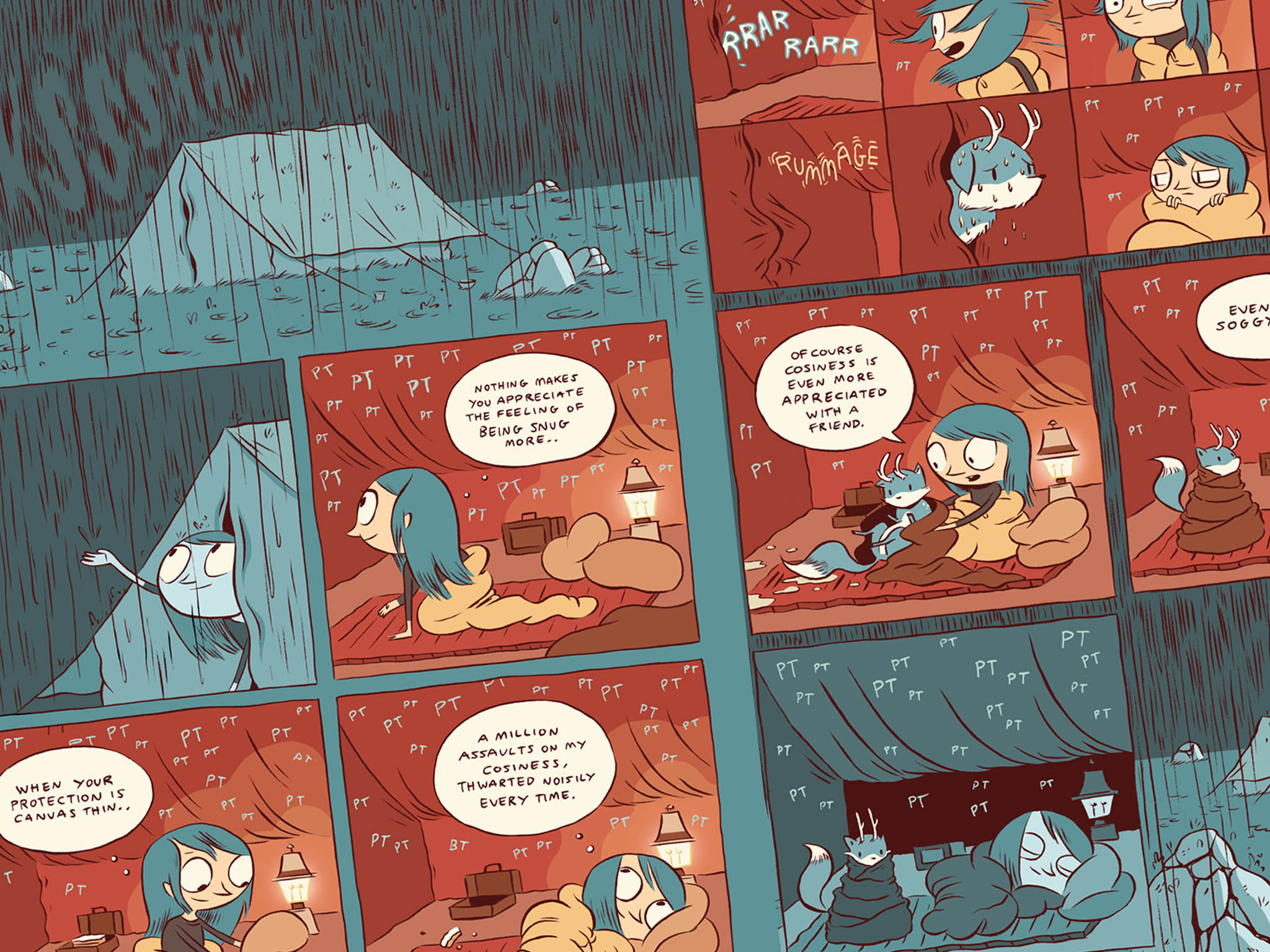
The next was Hilda and the Troll by Luke Pearson, which is part of a great series of books, done in a comic style rather than traditional story book format, which I think would be good for my story, to help condense the imagery down a little bit so the book doesn't end up being too long.

One Night, Far From Here by Julia Wauters, uses both normal paper and printed acetate to give another dimension of storytelling to her book. I think this would work quite well with mine, maybe combined with the puzzle pages, to make the book extra special.
Subscribe to:
Comments (Atom)